
I hear it constantly now. "We want to deploy an AI agent." Great. What data does it have access to?
The answer I usually get back sounds something like this. "Most of it is in e-automate, some policies are in a folder somewhere, our service knowledge is basically with our senior tech who has been here for fifteen years, and the rest is in people's heads."
That is the real problem. Not the AI. The data.
Here is the honest truth about AI agents. They do not create knowledge. They organize and surface it. If your data is scattered, inconsistent, or locked in someone's head, your agent will be scattered, inconsistent, and know nothing useful. You can have the best model on the market and it will still give your customers garbage answers if the underlying data is garbage. This is not a technology problem. It is a documentation problem that has existed for years, and AI is finally making it impossible to ignore.
The starting point is your e-automate data. Before you deploy anything, run these eight processes and fix what they surface: ID20, ID293, ID156, ID305, ID157, ID337, ID759, and ID838.
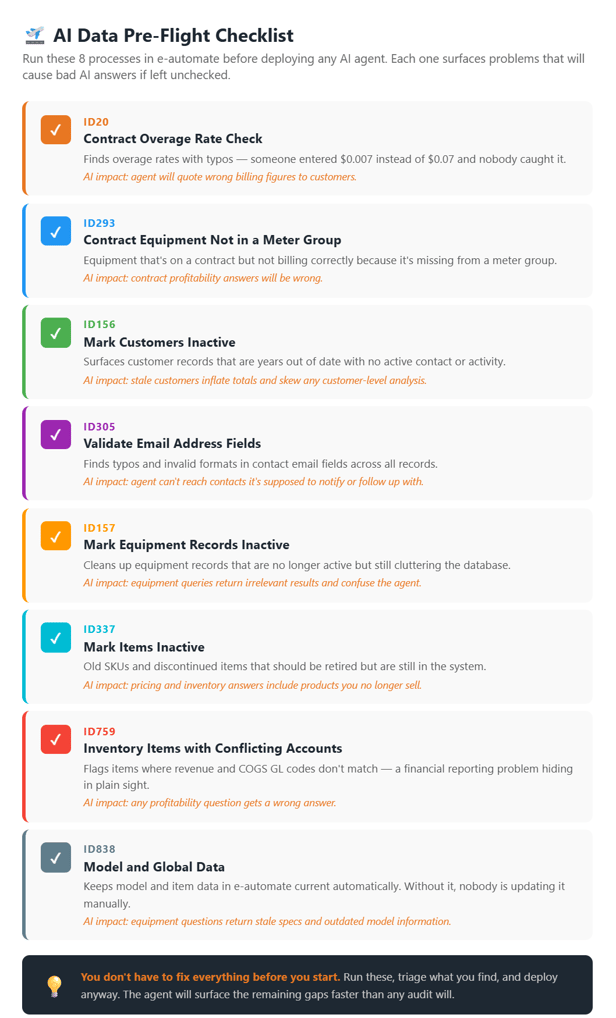
These are not edge cases. We see them in the majority of the databases we look at. A few hours fixing what these eight processes surface will save you months of chasing bad AI answers. The full list is at support.ceojuice.com.
Do not get stuck here.
This is the point where a lot of dealers stop moving. They see the list above, they see the work, and they decide they need everything perfect before they deploy anything. That is the wrong call.
Clean enough is good enough to start. Deploy, watch where it fails, fix the underlying data, and improve. That feedback loop is how you go from 60% accurate to 95% accurate. Waiting for perfect data gets you zero percent.
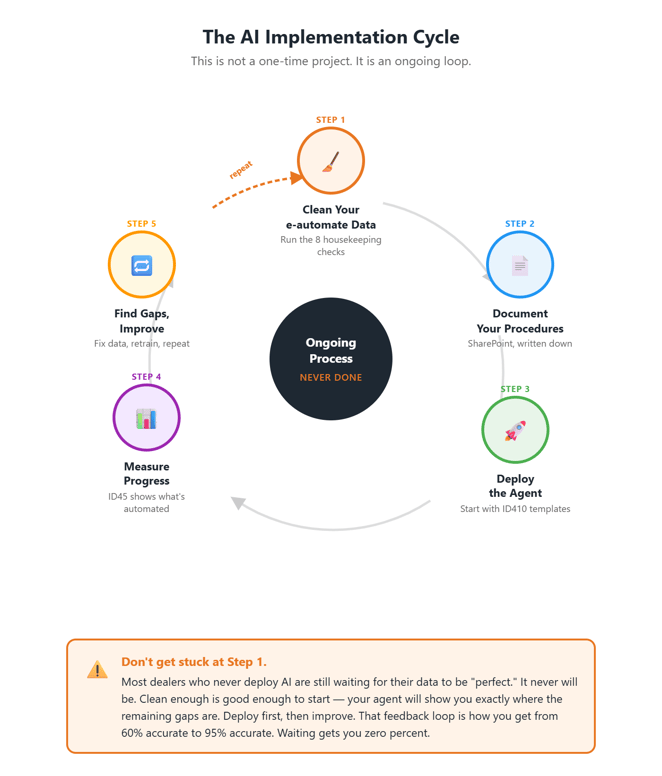
This is not a one-time project. It does not end after the first deployment.
Beyond the structured data in e-automate, think about what the agent needs to know that is NOT in a database. Your dispatch process. Your escalation procedures. Your service level agreements. Your pricing rules and exceptions. Your standard responses to common customer questions. This knowledge is probably in someone's head or in an email chain from 2019. Before you can train an agent to handle any of this, it needs to be written down and stored somewhere searchable. SharePoint is the natural home for Microsoft-stack dealers. This is the same work you should be doing when you onboard a new hire. You would not expect a new dispatcher to learn your escalation process by osmosis. Do not expect your agent to either.
Once you have done this work, clean e-automate data, current model records, documented procedures in SharePoint, that is when ID45 becomes genuinely useful. ID45 is our Power BI Automation Goals dashboard, and what it does is show you exactly how much of your business is already automated versus still being done manually. It breaks down your transaction volume by activity type, calculates the FTE capacity tied up in manual work, and puts a dollar figure on what automation is saving you compared to what it could be saving you. After you clean up the data and start automating processes, ID45 is how you measure the progress and identify where the next wave of automation should go. It is not a starting point. It is a scorecard.
Think about it this way. Building our ID588 MCP Server, the infrastructure that lets AI agents query your e-automate data and take action, is only as powerful as the data it is looking at. If the MCP server pulls from an e-automate database where contract billing is inconsistent and equipment records are stale, it will give inconsistent and stale answers. The pipe we are building is excellent. The data going into that pipe is your responsibility.
The last thing I will say is that this is a process, not a one-time project. JuiceAI, our own support agent, is trained on living documentation that we update every time it gets something wrong. Which still happens. We find the gap, fix the underlying documentation or data, and improve the agent. That feedback loop is how you go from an agent that sort of works to one that handles the majority of questions correctly. Build the foundation, deploy, watch where it fails, and improve it.
Do the foundational work. Then start. Your agent will show you everything else that needs fixing faster than any audit will.
Contact us at help@ceojuice.com or check out support.ceojuice.com for the full list of housekeeping processes to get your e-automate environment ready.

